Battlefield 6:
First-time User Experience
The first-time user experience in modern multiplayer shooters is often overwhelming. New players entering a complex title like Battlefield 6 face high cognitive load from learning UI systems in a fast paced game and immediate exposure to skilled players, as well as the challenge of understanding taxonomy and organization of a longstanding franchise in frontend menus.
In past Battlefield installments we had faced early churn and reduced engagement from new players, as well as feedback that the franchise felt unapproachable or "elitist." As a result we wanted to create a system that helped new players learn the menu and in-game mechanics without annoying our long-standing player base who would be resistant to being taught.
This created a nuanced design challenge: we needed to design a first-time user experience that reduced friction while preserving the depth and intensity expected from the Battlefield franchise.
My Role &
Design Process:
As the UX designer responsible for first time user experience,
I owned the end-to-end process of researching and developing a strategy for tutorials and long-term player learning and engagement for Battlefield 6. My responsibilities included:
-
Identifying onboarding patterns in comparable games like Apex Legends and Call of Duty
-
Established guiding principles and frameworks for onboarding, tutorialization, and long-term player engagement
-
Designed for scalability, ensuring systems could support new content, features, and evolving player needs post-launch
Research Synthesis
To ground our approach, I conducted a comparative analysis of direct competitors alongside adjacent games known for strong onboarding and accessibility. This included titles like Apex Legends and Call of Duty, as well as indirect benchmarks with highly rated tutorial systems like The Last of Us. The goal was not to replicate features, but to understand how different games introduce complexity, pace learning, and build early player confidence.
Across this research, a clear pattern emerged: successful onboarding systems were not confined to a single tutorial moment, but instead distributed learning over time through contextual cues and reward-driven progression.
To deepen these insights, I collaborated with UX researchers from Apex Legends, gaining access to a diary study that tracked new player behavior over time. This revealed two critical opportunities: first, that early exposure to low-stakes environments (such as bot-enabled modes) significantly reduced churn; and second, that reinforcing progress through post-match rewards increased player motivation to re-engage.


In-game Tutorialization
Our initial vision for onboarding centered on an open-world training mode, where players could explore freely and engage with self-paced mini challenges. Rather than forcing a linear tutorial, this approach allowed players to choose what to learn and when, supporting different playstyles while reducing the pressure often associated with first-time experiences.
For this mode I developed a system for objective identification as the player explores as well as a tooltip system to encourage interaction learning that wasn't obstructive to trial and error learning. The mode was still being built in world, so I utilized AI to help create backgrounds that would communicate storytelling in my wireframes and help the dev team understand pacing with the user experience.
As development progressed, scope shifted and the open-world mode was ultimately cut in favor of streamlined versions of core multiplayer modes with heavy bot integration. While this changed the delivery, it reinforced the importance of low-stakes learning environments identified in earlier research.
The tooltip system, however, was carried forward and implemented into the shipped experience, ensuring that contextual, non-intrusive learning remained a core part of onboarding even as the solution evolved.
Frontend Menu Tutorialization
Designing tutorialization for the frontend required a more nuanced approach than in-game systems. The menu needed to introduce foundational concepts, such as Battlefield’s class system, to new players, while also surfacing new features and customization options for returning veterans without slowing them down or feeling intrusive.
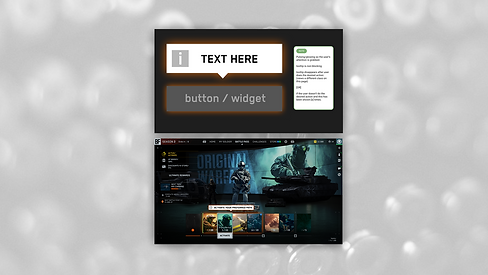
To address this, I designed a behavior-driven tooltip system embedded within the frontend experience. This included lightweight tooltips triggered on first interaction to introduce key systems without overwhelming the player and contextual prompts that appeared over time based on player progression or lack of engagement with high-impact features. The pacing model prioritized relevance, ensuring players only saw guidance when it aligned with their current goals or gaps in understanding.
In addition, a key principle was minimizing disruption. All tutorial elements were designed to be easily dismissible, avoiding forced interactions that could frustrate experienced players. I also advocated for a global opt-out setting, giving veteran users full control to disable tutorialization entirely.

Player Guides
As part of the broader onboarding strategy, I proposed a Player Guides feature to support learning beyond first-time interactions. While tooltips addressed just-in-time guidance, this system created a reliable, self-serve resource for both new and returning players to deepen their understanding at their own pace.
The feature was designed to live within the options menu, making it consistently accessible without interrupting gameplay. It served as a centralized hub for explaining core systems, such as the class structure, loadouts, and feature-specific mechanics, while also acting as a reference point for players re-engaging after time away.
To ensure cohesion across the experience, the guides were conceptually linked to the tooltip system. Tooltips acted as lightweight entry points, introducing features in context and players could opt into expanded explanations through the guides when they wanted more depth.
Player Rewards
Post-launch, we identified an opportunity to strengthen engagement and reduce early drop-off by reinforcing player progress more clearly. Returning to our initial research, one of the most consistent drivers of retention was reward loops that gave players a sense of momentum and purpose.
In response, we introduced a structured set of early-game challenges tied to match completion and core gameplay behaviors.
We created short-term challenges that rewarded players for simply participating and finishing matches, lowering the pressure to perform and rewards that gave players an early taste of long-term progression, increasing motivation to continue.
This system complemented our onboarding efforts by shifting the experience from “understanding the game” to “feeling rewarded for playing it.”

Next Steps
While the shipped experience established a strong foundation for onboarding and early engagement, there are opportunities to evolve the system.
The team continues to explore how to implement the guides system with the desire to integrate richer media (video, interactive walkthroughs) and connecting guides more directly to live gameplay scenarios to strengthen its role as a bridge between passive learning and active play.